For AIS2026 - European Commission AI for Science Summit, Dublin, October 2026, Read in 20mins, or see this Highlight Reel, Video (coming soon).
Abstract: In the 1660s, Robert Boyle, born in Lismore, County Waterford, wrote down twenty-four things he hoped science would one day achieve. He also helped found the Royal Society, whose motto was nullius in verba: on no one's word. Ambition and scepticism were born together. AI has now transformed some sciences in a few years and barely touched others, and this talk asks why. Protein structures that once took a PhD now take seconds. Weather forecasts now take a minute on a single chip. Machines propose proofs and hypotheses, and scrolls buried by Vesuvius can be read again. In each case, the result was believed because a way to check it already existed: a blind test, a scorecard, a proof checker, an expert who could say no. Where no such check exists, we get slop. Checks set the pace of science, and its direction. Many of the checks that made these advances possible were built as shared, public institutions, much of that work in Europe. That makes building the next ones a public agenda. But a check can tell us whether something is true, not whether it is good, and those who build, fund and use these tools share that responsibility. Boyle could not check a single item on his list. He wrote it anyway, and then helped build the means to check. That is the invitation of this talk: to scale our ambitions, to write down what we cannot yet do, and to build, together, the means to believe it when it arrives.
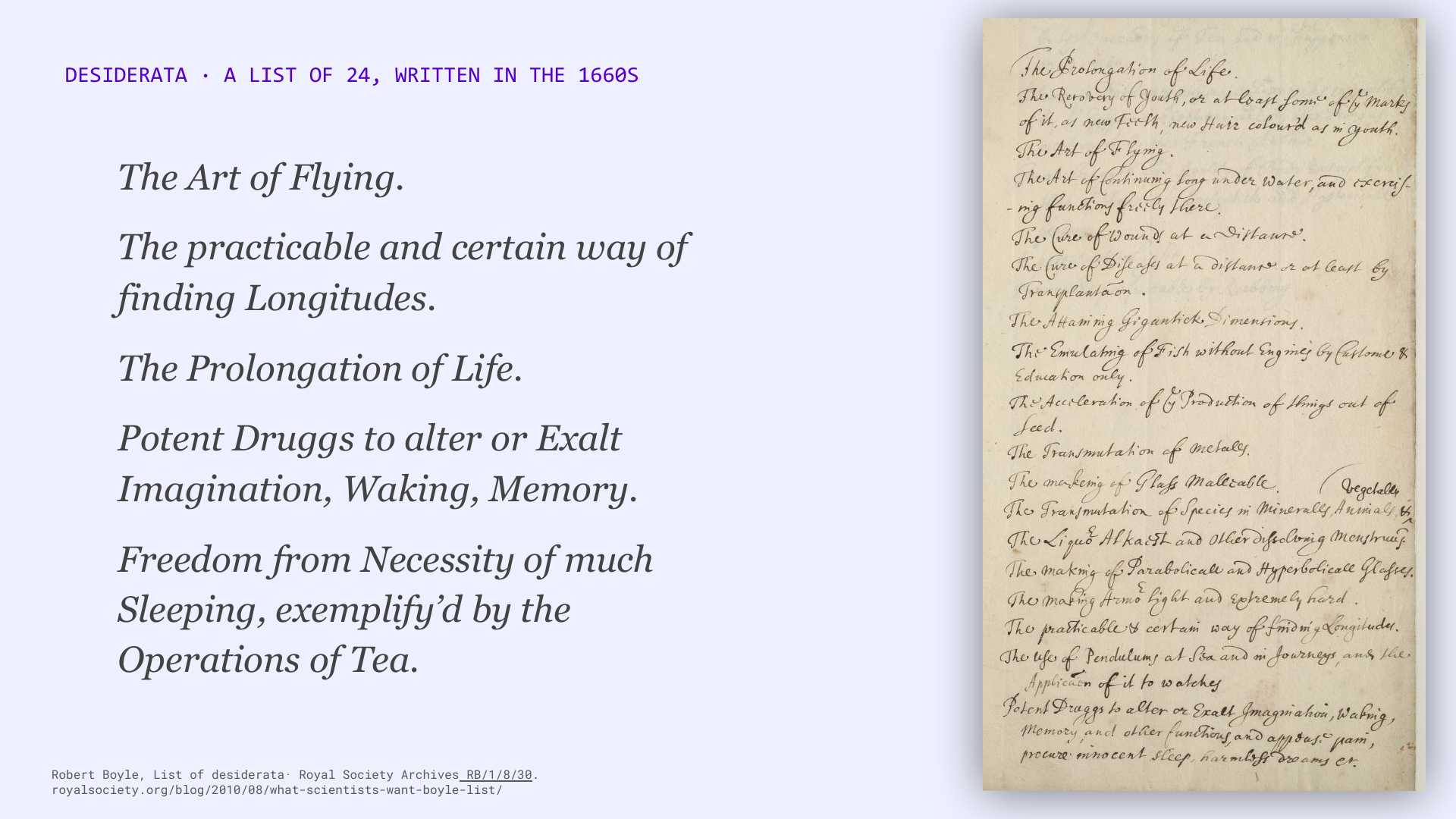
Boyle’s list
- The Art of Flying.
- The practicable and certain way of finding Longitudes.
- The Prolongation of Life.
- Potent Drugs to alter or Exalt Imagination, Waking, Memory.
- Freedom from Necessity of much Sleeping, exemplified by the Operations of Tea.
That list was written in the 1660s by a man born in Lismore, in County Waterford. It had twenty-four items.
His name was Robert Boyle. He is most known for the law of physics that bears his name, about the pressure and volume of a gas. In the same decade that Boyle wrote this list of scientific ambitions, he helped found the Royal Society in London, one of the first scientific societies in Europe, and it chose a motto: nullius in verba. On no one’s word.
Within the same few years, and among the same people, you have a list of things nobody could do, and a rule that nothing should be believed without checking. Ambition and scepticism were born together. I've come to know that you can't do science with only one of them.
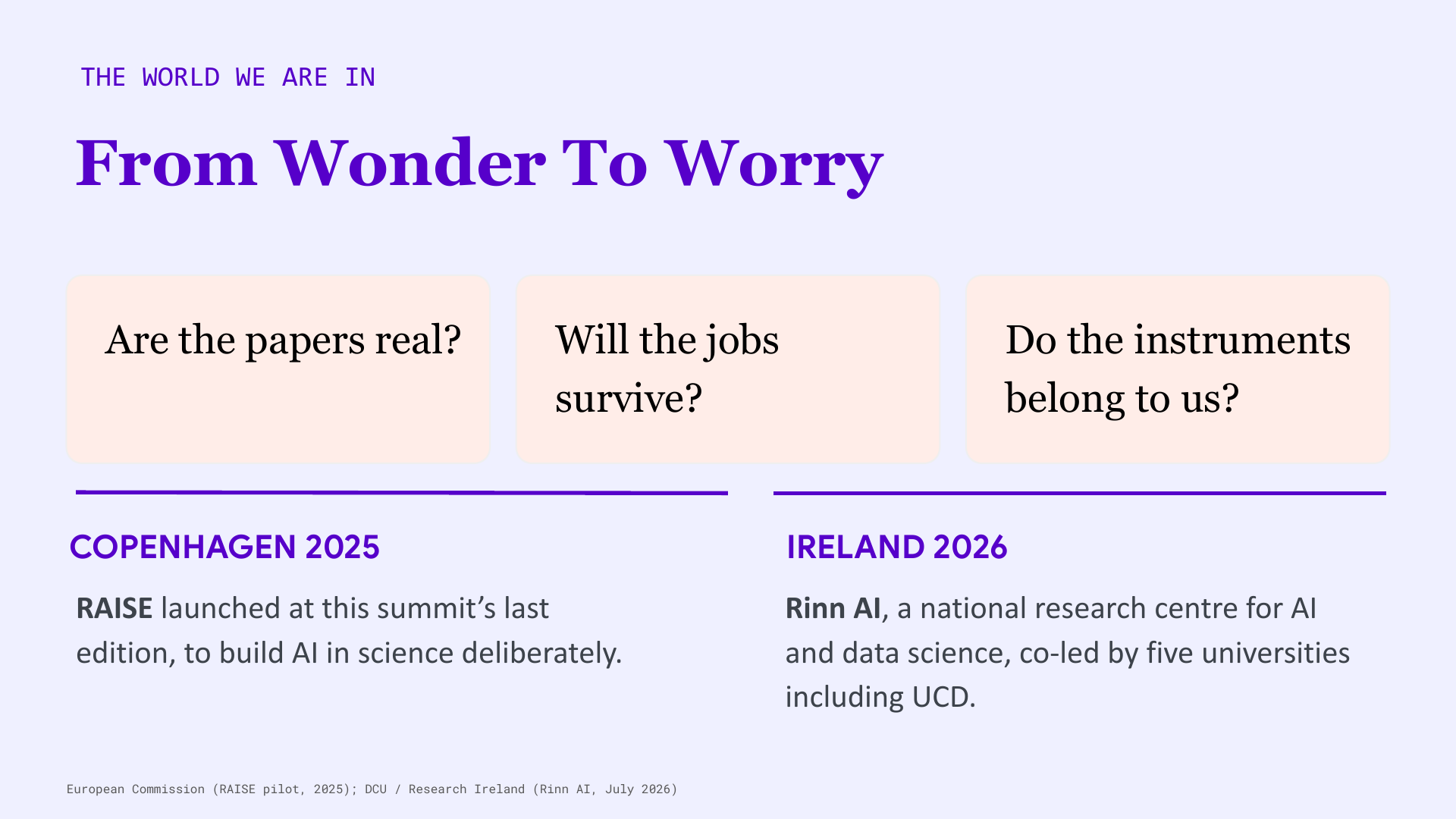
But ambition is harder to talk about this year. The conversation about AI and science has moved from wonder to worry: whether papers are real, whether jobs survive, and whether the instruments belong to us. Those worries are fair. They're also being answered, and some of the answers started at this summit. A year ago in Copenhagen, Europe launched RAISE, because it decided AI in science needs deliberate building. This summer, Ireland opened Rinn AI, a new national research centre for AI and data science, with UCD, our host this morning, among the universities leading it.
Let’s go back to Boyle. He wrote his list and waited. He lived to see almost none of it. Science has moved faster in my working life than in almost any stretch of his; and I've been lucky to watch some of it up close. I want to show you four places where AI has changed what science can do, and one where it hasn't yet. And then put to you the question that has been most on my mind.
Not why AI has done so much in science. Instead, why has it done so much in some sciences, and so little in others?
The answer has less to do with AI models than you might think. It is about us, and about what we have built to check those models.
Science moves at the speed of its checks.
And that decides how ambitious this continent can be. By checks, I mean the ways scientists find out whether something is true: a blind test, a measurement, an experiment someone else can repeat. Most of them were built by scientists, for science. So. Let me start with a test.
A Blind Test
In 1994, a group of scientists got tired of everyone claiming to have solved the same problem. So they set up a competition.
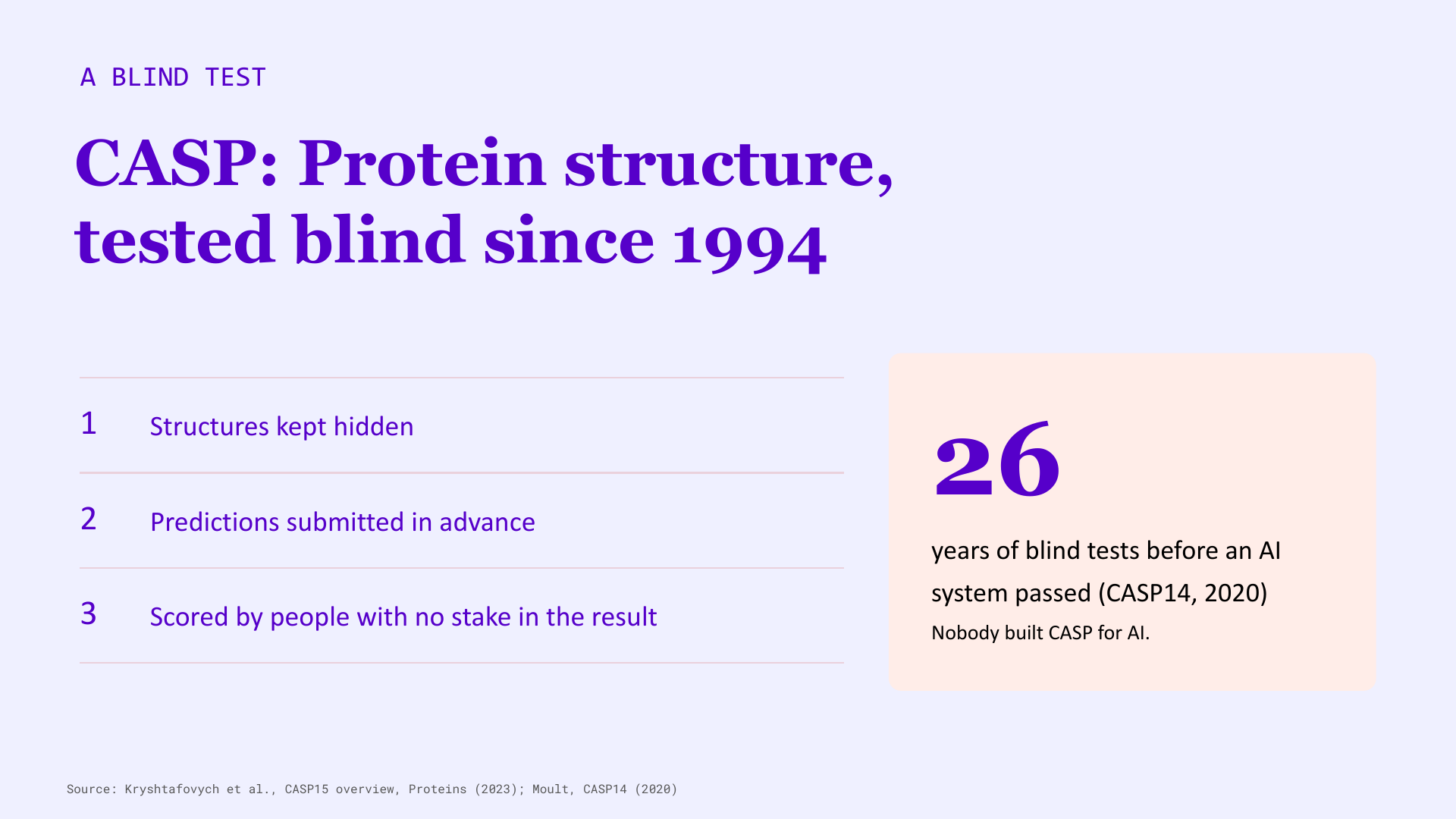
The problem was one of the hardest in biology: working out the shape of a protein from its sequence. Shape is function. Know how a protein folds, and you can begin to understand what it does, and how to stop it. Determining a single structure could take an entire PhD. Three, four years at the bench.
Their test was simple and strict. Structures kept hidden. Predictions submitted in advance. And scored by people with no stake in the result. It was called CASP, and it ran every two years, and for a long time progress was slow.
Then in 2020, AlphaFold — built by my colleagues at Google DeepMind — predicted protein structures accurately enough that the field judged the problem largely solved. Today there are more than two hundred million predicted structures, open to anyone, hosted here in Europe at EMBL-EBI, and used by millions of researchers. Two years ago the work was recognised with a Nobel Prize.
Nobody built CASP for AI. It had been running for twenty-six years before an AI system passed its test. That is why the result was believed so quickly.
The model learned from the Protein Data Bank, which Europe helps run: decades of structures determined by hand and made public.
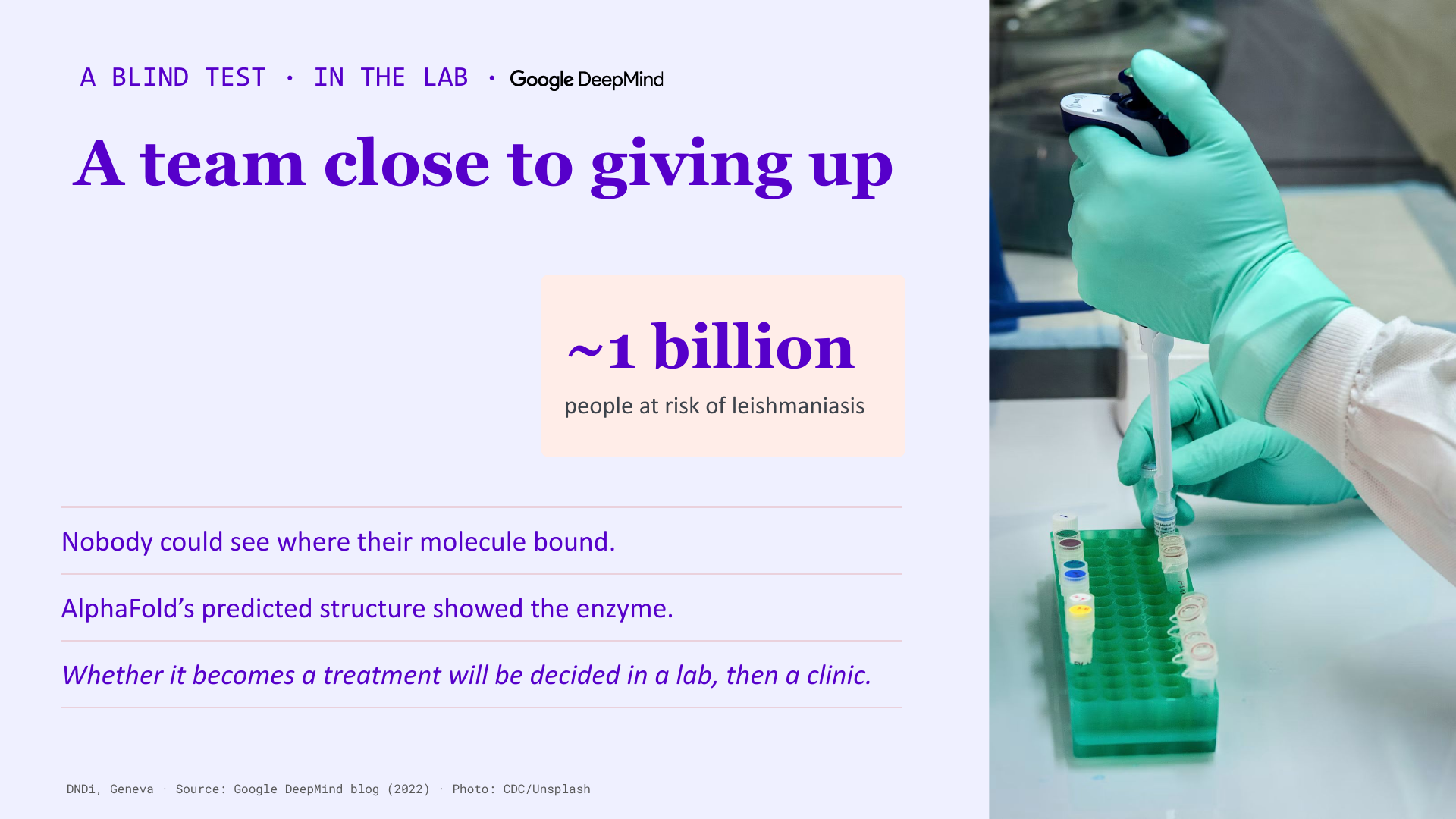
In Geneva, a team working on leishmaniasis, a parasitic disease that puts a billion people at risk, most severely in children, had a promising molecule. Nobody could see where the drug was binding, and their efforts to improve it were going nowhere. They were close to giving up. A structure predicted by AlphaFold let them see the enzyme involved, and think afresh about how to redesign the molecule. This may never become a treatment. Whether it does will be decided in a lab, and then in a clinic. But that prediction changed where they started, and which experiments were worth running at all.
A Scorecard
Finding longitude is on Boyle’s list. It was solved a century later, with a public prize and trials at sea. But next week’s weather isn’t. It never occurred to him to want it. A list of wishes is bounded by what you can imagine wanting.
For most of the last century, forecasting meant writing down the physics of air and water and heat, and solving it on some of the largest computers on Earth. Now there is a second way: learn how the atmosphere moves from decades of its own history.
With AI, a ten-day global forecast can be produced in about a minute, on a single chip. These forecasts are more accurate than the best operational system on most of what forecasters measure, allowing earlier warnings of where a cyclone will come ashore. Access to that computing power is now part of having a scientific instrument.
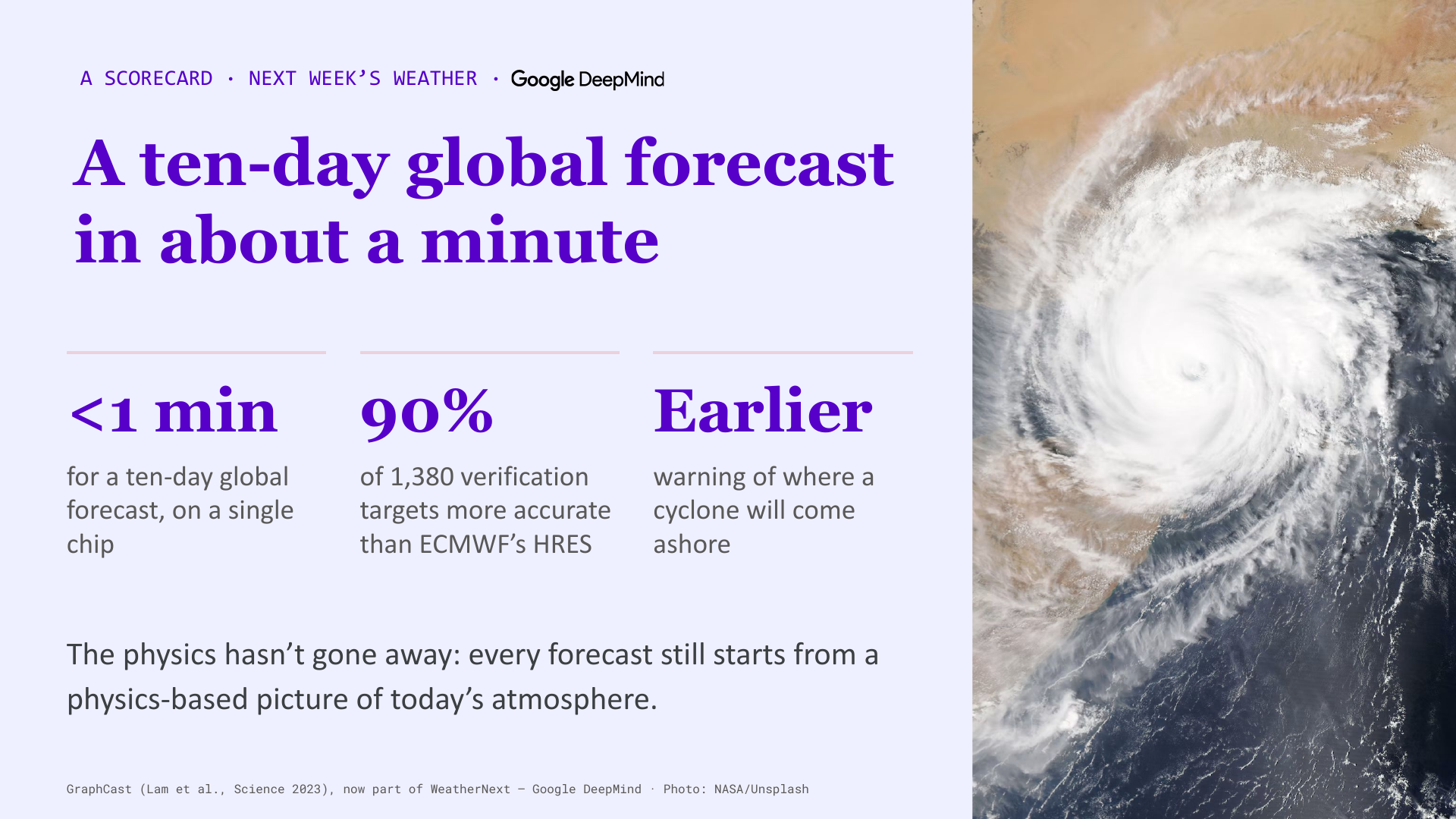
The physics hasn’t gone away: every forecast still starts from a physics-based picture of today’s atmosphere. What’s changed is that the model has learned how it evolves from that starting point.
We believe these forecasts because of a scorecard. Every square is something forecasters care about. Blue where our AI model beat the operational forecast; red where it didn’t. And the southern hemisphere is scored separately, so failures can’t hide inside an average. Forecasters have long kept score like this.
The forecast every model is scored against is Europe's own, and the transformation begins there.
The European Centre for Medium-Range Weather Forecasts rebuilt the planet’s weather, hour by hour, going back decades, and made it open, through Copernicus. We learned from that record, and showed that a learned model can beat operational forecasts. The Centre then built its own, and since February last year it has run an AI forecasting system every day, side by side with its physics.
Each step depended on the one before. Open public data. A private lab building on it. A public forecaster going further. No one gets there alone.
The Proof Checker and the Laboratory
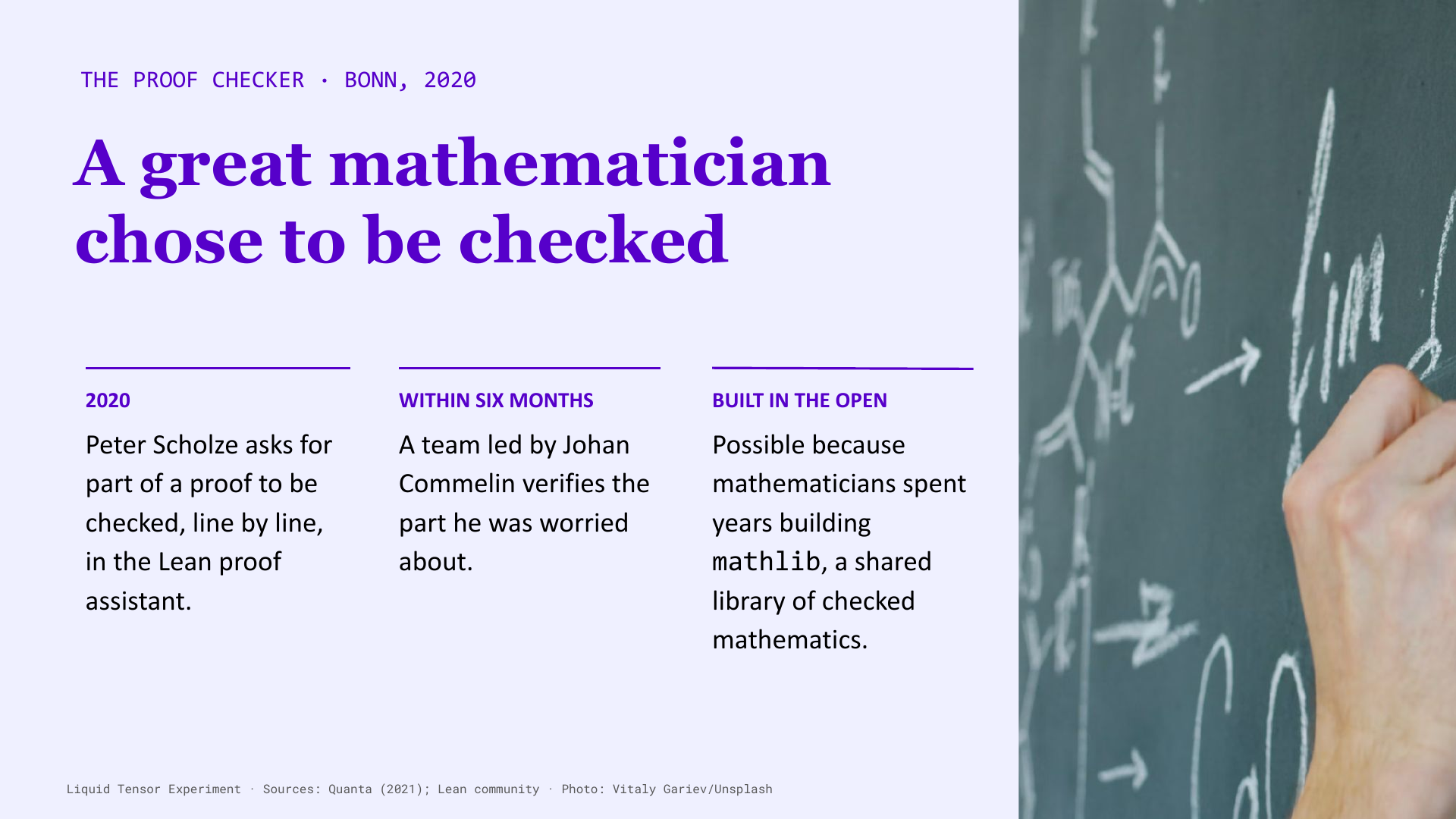
In 2020, Peter Scholze, in Bonn—one of the greatest mathematicians of his generation—was not fully sure of part of a proof he considered among his most important. So he asked his community to check it, formally, by machine, line by line, in a proof assistant called Lean. Within six months, a team led by Johan Commelin had verified the part he was worried about. They could do it because mathematicians had spent years building a shared library of checked mathematics, in the open.
That kind of checking matters more now, because machines no longer just carry out our plans or check our work. They've begun to propose: conjectures, proofs, algorithms and hypotheses, at a scale no group of people can match.
Generating hypotheses, reading the literature, trying an idea to see if it breaks: that is what many of you do for a living. It is what I do. Watching a machine do it is genuinely unsettling.
Last year our system reached gold-medal standard at the International Mathematical Olympiad, graded by the Olympiad's own coordinators. In biology, systems now propose hypotheses that laboratories go on to confirm, including existing drugs that might be turned against leukaemia.
Yet much of what these systems propose is wrong, or trivial. We believe the ones that survive because something can say no. In mathematics, a proof checker, line by line. In biology, the oldest check of all: a laboratory, and someone willing to run the experiment. And even a lab result is only a first step. A drug that works in a dish still has to work in a person.
Proposing was never the hard part.
An Expert Who Says No
Potent drugs to exalt the memory. That one's on his list too.
We didn't get the drug. We got something stranger: machines that help us recover what we had lost. And here the check is the oldest one we have: a person who knows the material, and is willing to say no.
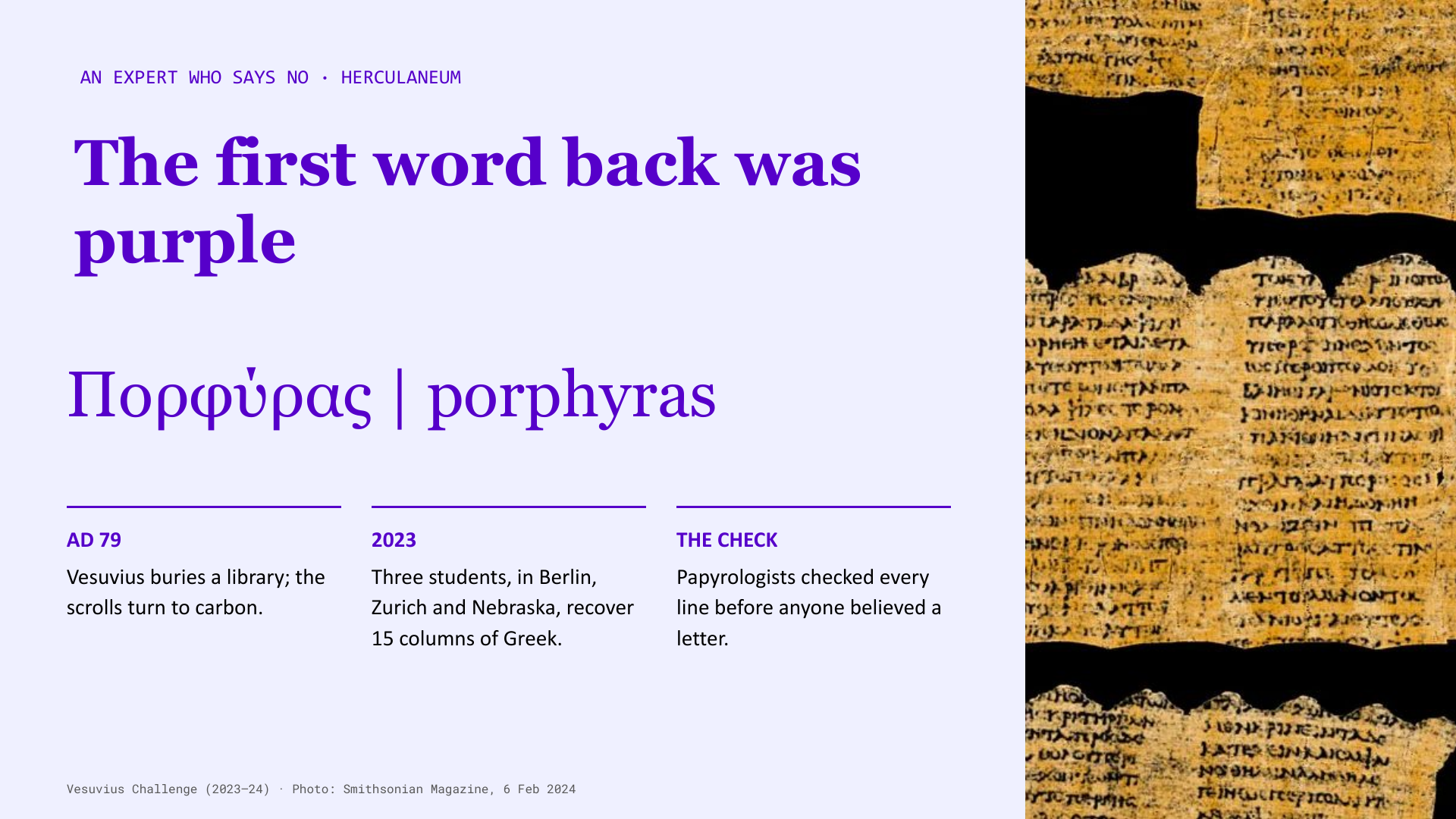
In the year 79, Vesuvius buried a library at Herculaneum. The scrolls were turned to carbon; try to unroll one and it crumbles. In 2023, an open competition asked anyone in the world to read them from X-ray scans. The first word to come back was purple.
Within months, three students—one working in Berlin, one in Zurich, one in Nebraska—had recovered whole columns of Greek: a philosopher, writing about pleasure, in a text nobody alive had ever seen. And we believe it because, before anyone accepted a single letter, papyrologists checked every line.
The same is happening with Latin inscriptions: a model we built with historians proposes what's missing, and when and where a text was written. But the historians decide what to believe.
That check took centuries to build: generations of scholars, much of it in this continent's universities, learning to read these texts one fragment at a time. The models learned from that scholarship. The scholars still have the last word.
Where There is No Check
A blind test. A scorecard. A proof checker. An expert. So far, every story has had a way to check. Here's what happens when there isn't one.
Few of us can keep up with the literature of our own field, and machines now read it with us. They're useful. But this is where things have gone wrong. Generation got cheap before checking did. Papers nobody asked for, grant proposals nobody wrote, reviews nobody read, results nobody can reproduce, and editors and funders who can't keep up. More output has never meant more progress. AI has made answers cheap. It has not made them true.
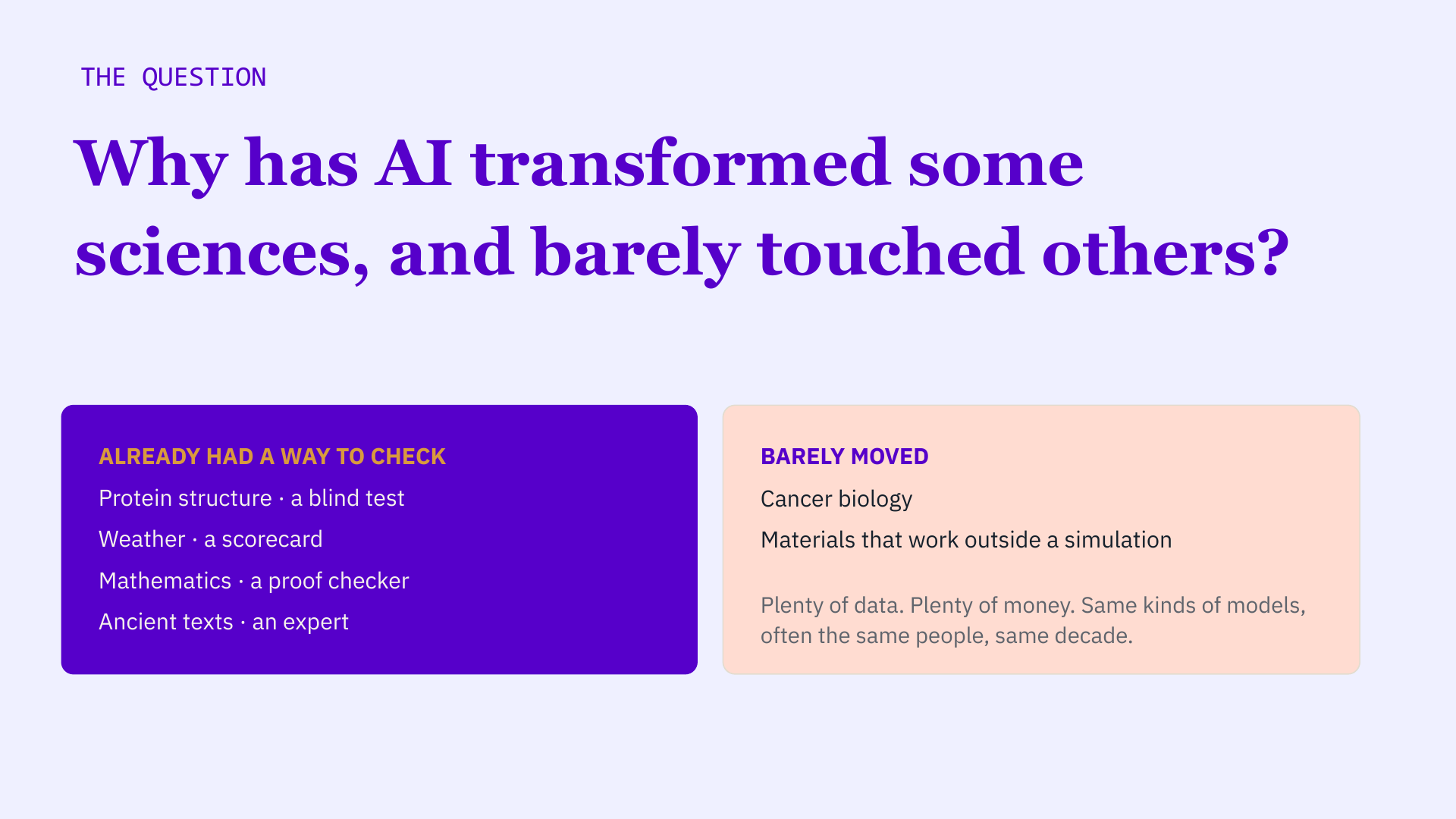
There are also sciences just as important as protein structure, with plenty of data and plenty of money, that have barely moved. Cancer biology. Materials that work outside a simulation. Same kinds of models. Often the same people. Same decade.
So why has AI transformed some sciences, and barely touched others? It's that some sciences had already built a way to check. And the check was there before the model arrived. That's why the results were believed, and why they came so fast. Where there's a way to check, we get results like AlphaFold. Where there isn't, we risk slop, and results nobody can trust.
In any discipline, scientific progress is strictly limited by our capacity to measure relevant concepts.
Science moves at the speed of its checks.
But there are two complications to this.
The first is that while a way to check is necessary, it is not sufficient. RNA structure has a check, and AI still struggles there. There are too few solved structures to learn from or check against.
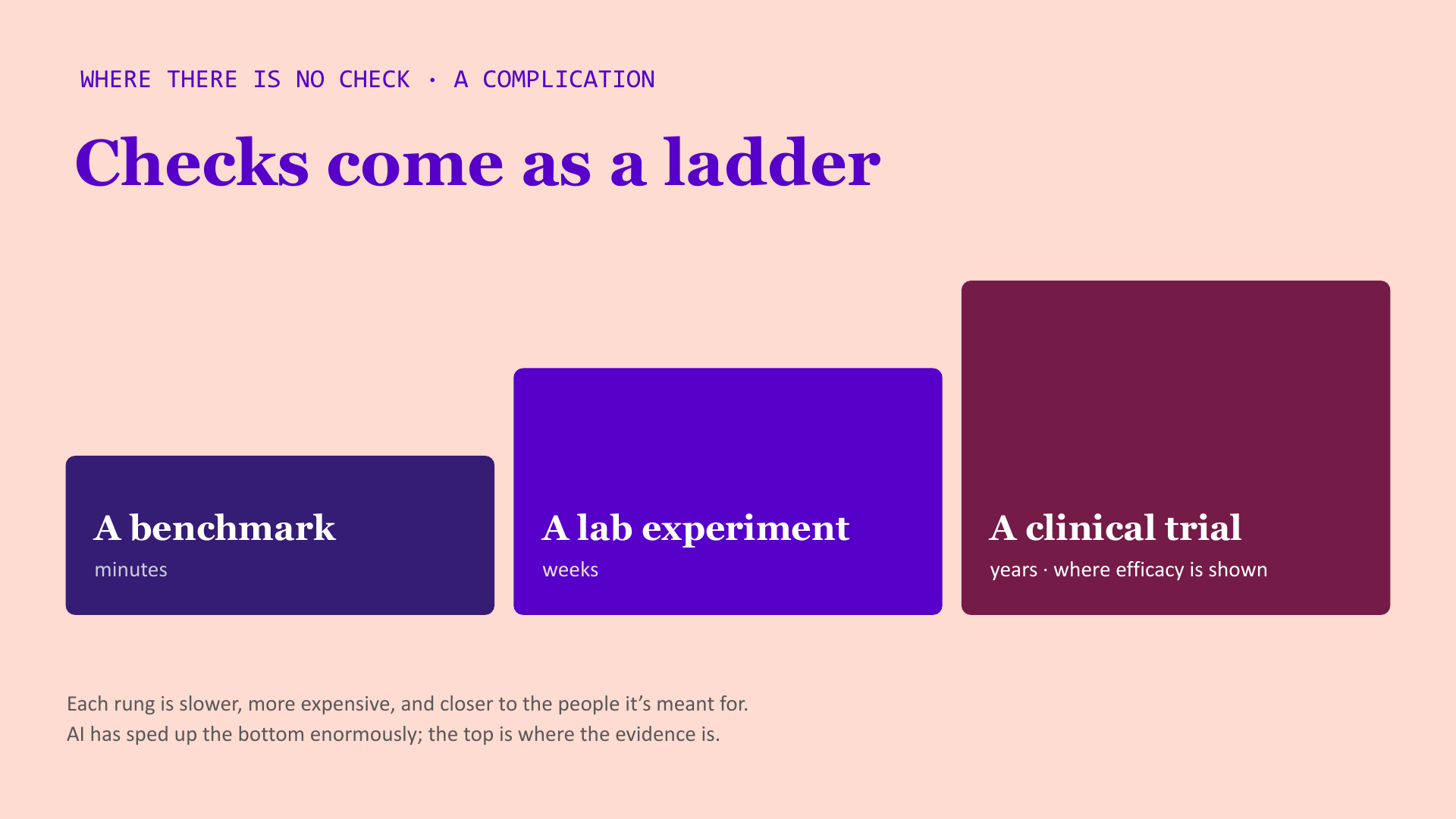
And checks come as a ladder. A benchmark runs in minutes. A lab experiment takes weeks. A clinical trial takes years. Each rung is slower, more expensive, and closer to the people it's meant for — and only the top one tells you whether something actually works for them. Most medicines that look promising in a lab never reach patients.
AI has sped up the bottom of the ladder enormously. The top is where the evidence is, and it hasn't moved nearly as fast.
The second is that checks don't only set the pace. They set the direction. A study in Nature this year, of forty-one million papers, found that scientists using AI publish more and are cited more. But science as a whole is narrowing, towards the fields where data is richest and progress easiest to show. If we only build checks where checking is easy, our ambition will shrink to fit them.
What’s Left for Us
This also answers a question a lot of people are asking quietly this year: what’s left for us to do?
When answers get cheap, judgement about which ones to trust becomes scarce. Someone has to decide what counts as a good answer. Someone has to design the blind test, and hold back the evaluation data. And say no. That is judgement, and it is the part of science that gets more valuable as generation gets cheaper.
It's already happening in how we fund science. When a polished proposal costs nothing to write, the question for a funder shifts from “is this well written?” to “does this person understand, and believe in, what they're asking to do?” That's a check only people can run.
There's a quieter version of that worry, and I have it myself: that we stop sitting with the problem, and the next generation never builds that judgement at all. The same tools are now in every classroom, and we can't yet tell whether the students using them are learning and whether they could do it next month, without the machine.
I don't think the answer is to use these tools less. It's to hold on to the part of the work that makes us scientists and thinkers: the checking. Because checking is how judgement grows, in a student, and in a field, and across a continent.
Call to Europe
Which brings it back to this room. If a way to check is what unlocks a field, then shared evaluations, open data, models scientists can actually use, and the compute to run them aren't overheads on science. They decide which sciences move next.
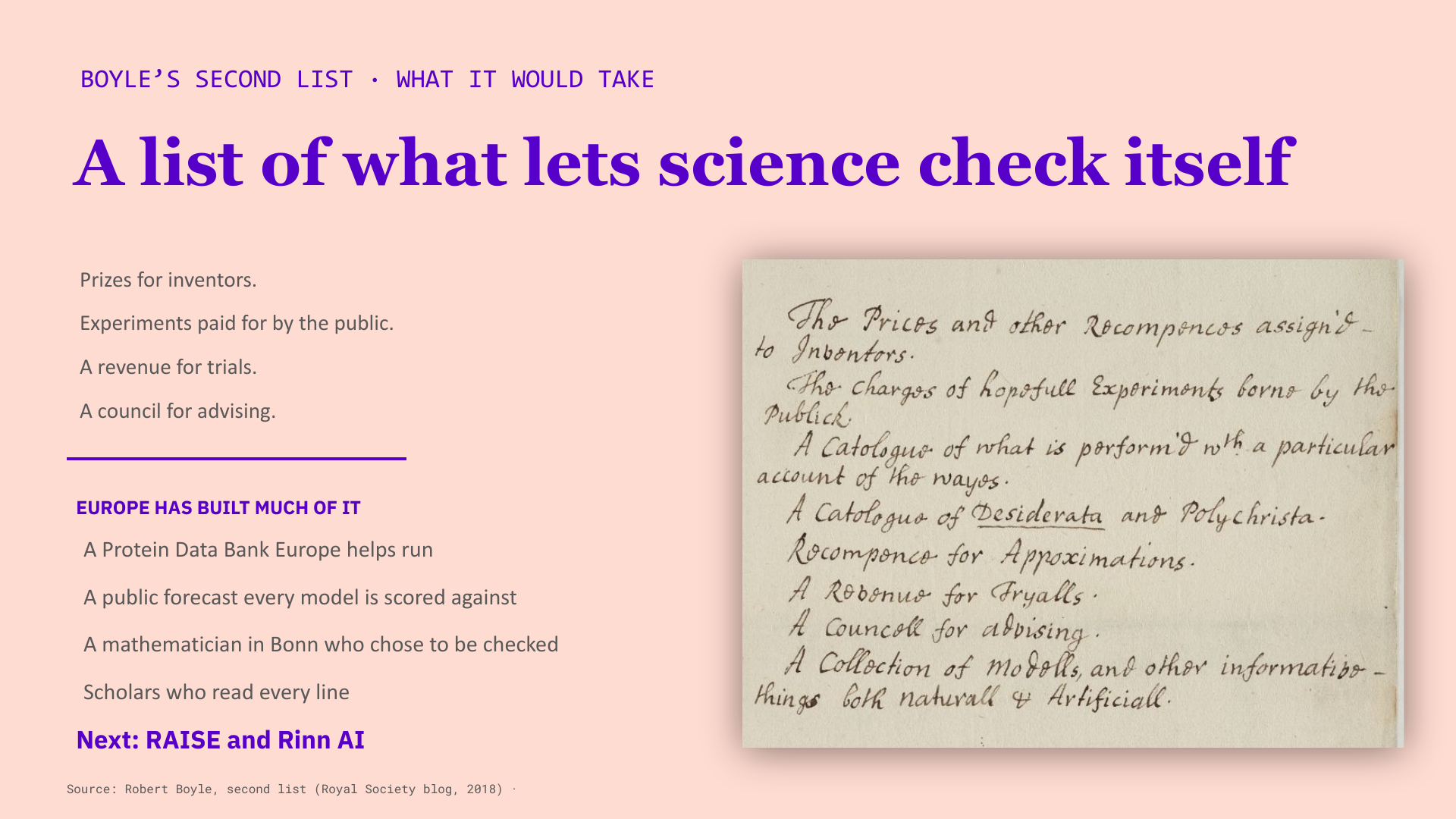
Boyle understood this. Alongside his list of wishes, he wrote a second list. Not what he wanted, but what it would take. Prizes for inventors. Experiments paid for by the public. A revenue for trials. A council for advising.
That's a list of what lets science check itself. And Europe has built a great deal of it. You've seen some this morning: a Protein Data Bank that Europe helps run; a European public forecast that every model is scored against; a mathematician in Bonn who chose to be checked; scholars who read every line.
I don't think that's an accident. A continent of many languages and many institutions has always needed shared checks to trust each other's science. That's why Europe built them. RAISE, and new centres like Rinn AI, are the chance to build the next ones, for the sciences that still don't have them.
Responsibility of the Pioneer
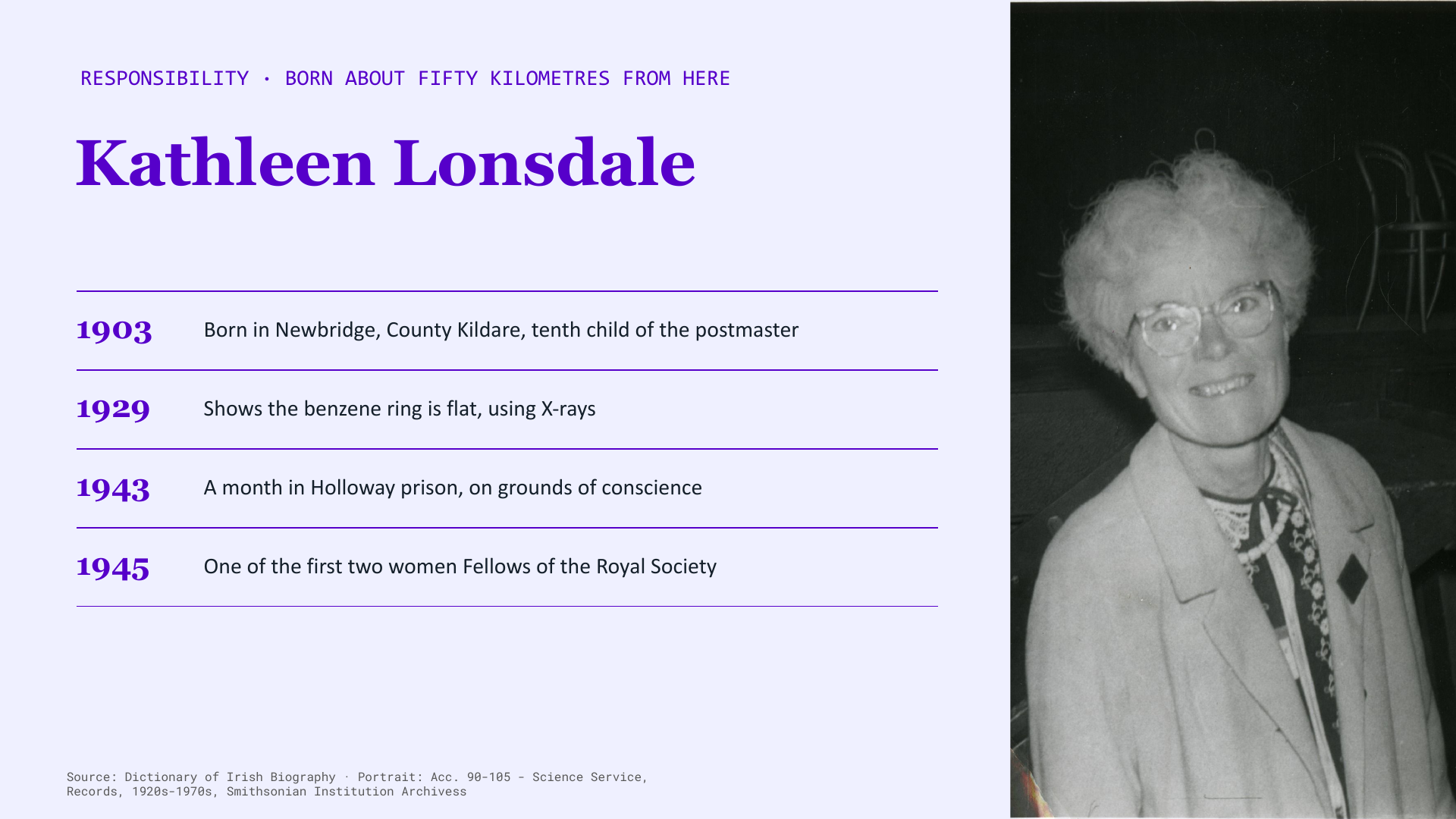
Let me introduce someone born about 50km from here. Kathleen Lonsdale was born in Newbridge, County Kildare, in 1903, the tenth child of the local postmaster. She became a crystallographer. In 1929 she showed that the benzene ring is flat, by pointing X-rays at a crystal and reading what came back. Every structure I showed you this morning stands on the field she helped build.
Boyle's society took nearly three centuries to admit a woman. In 1945, she was one of the first two.
In 1943, on grounds of conscience, she refused to register for wartime duties, and spent a month in Holloway prison rather than pay the fine. She spent the rest of her life arguing that scientists don't get to hand over what they know and walk away. She understood something no scorecard captures. A check can tell you if something is true. It can't tell you if it's good.
In the summer of 2022, Europe's heat forecasts were good, and many countries had heat plans in place. More than sixty thousand people across Europe still died. The forecast was right. But it didn't reach the people who needed it. There's no scorecard for whether something is good. So we need other ways to check.
At Google DeepMind, before we released the third version of AlphaFold, we asked more than fifty experts, including in biosecurity, what should be made available, and how. We release in stages, and stay involved in how our work is used. Each of those is a check we're still learning to build. And we can't build them alone. That work belongs to everyone who makes these tools, funds them or uses them, which is most of this room.
Boyle's list had twenty-four items on it. Some of them, we should be glad he couldn't achieve. But he wrote them down. And that's where it starts.
A New List
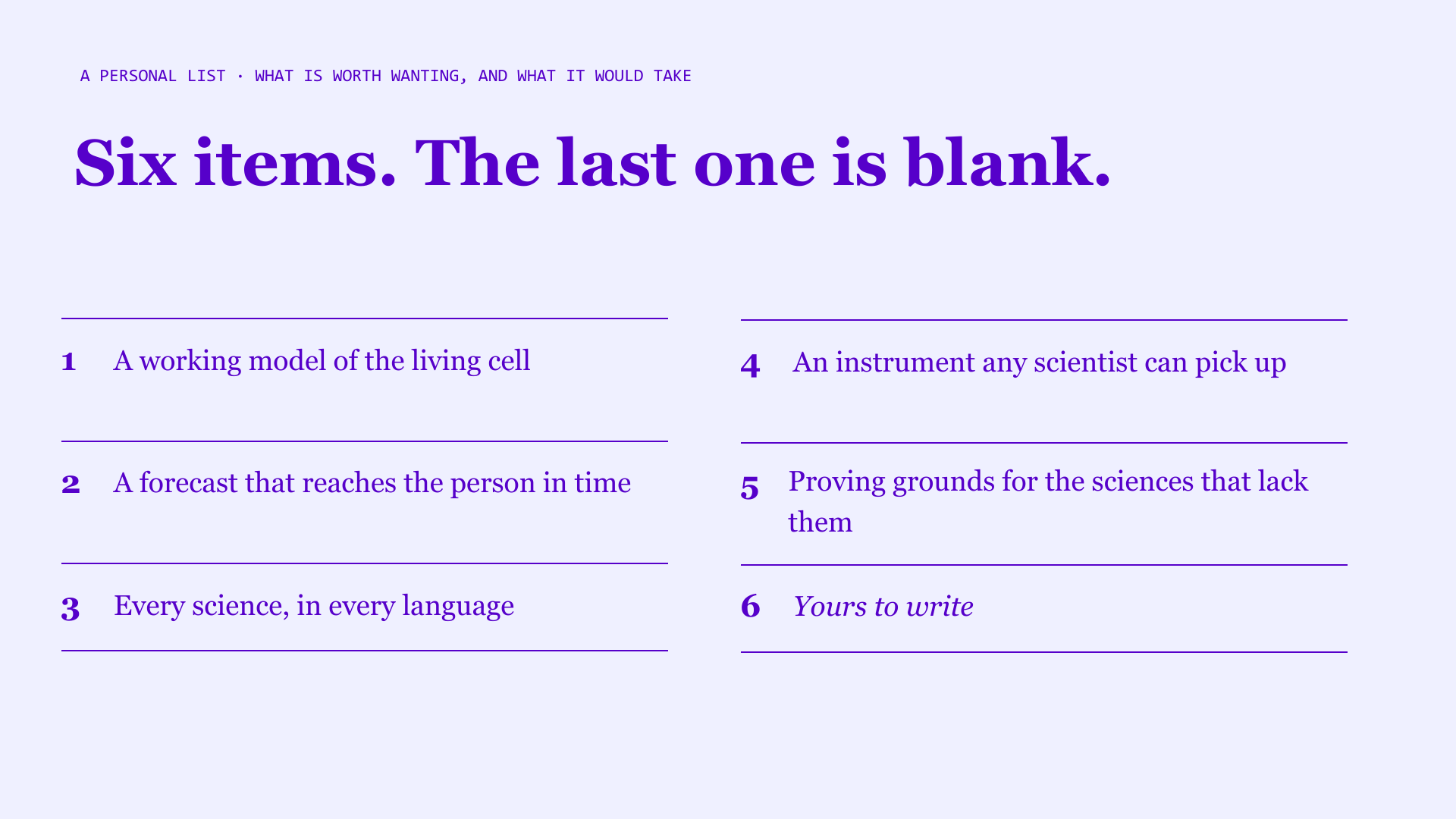
So here is mine, a personal one. Six items and the last one is blank.
- A working model of the living cell. The whole cell, running, so you can ask it a question and act on the answer. We have the parts list. We don’t have the machine, or a way to know when it’s right.
- A forecast that reaches the person in time. The hard part is no longer the forecast. It’s getting it to the nurse, the farmer, the harbour master while there’s still time to act.
- Every science, in every language. Most of the world’s scientists don’t speak English as a first language, but most of the world’s science is published in it. We now have tools that could open that door. Science has always depended on who gets a say in checking it.
- An instrument any scientist can pick up. Open data, models as open as it's safe to make them, and the compute to run them — the things that decide who gets to take part in science. A tool is most useful when you can afford it, and rely on it being there. This continent is already building its own: exascale machines; AI factories; a public forecaster running AI of its own.
- Proving grounds for the sciences that don’t have them. A CASP for cancer biology. A scorecard for materials. Benchmarks for education. Without them, our ambition shrinks to whatever is easiest to measure. A proving ground, not an audit, built by the scientists and scholars who know what a good answer looks like. And faster, shared routes up the ladder — from the lab to the clinic — so good ideas reach the people they’re for.
- Blank. Boyle could only list what he could imagine wanting. Most of what mattered in the three centuries after him isn’t on it. So the sixth item isn’t mine to write. It belongs to someone in this hall, maybe at the start of their career, maybe in a field I haven’t mentioned. That one is yours to write.
You may have heard yesterday that Google DeepMind is joining the Commission's AI in Science Enablers campaign. Scientists based in Europe will get access to our science models—for proteins, genomes, weather, earth observations, and coding agents—with, computing credits to run them, and hands-on support, including a hackathon next year. I see it as a small step towards item four.
The Hamilton Walk
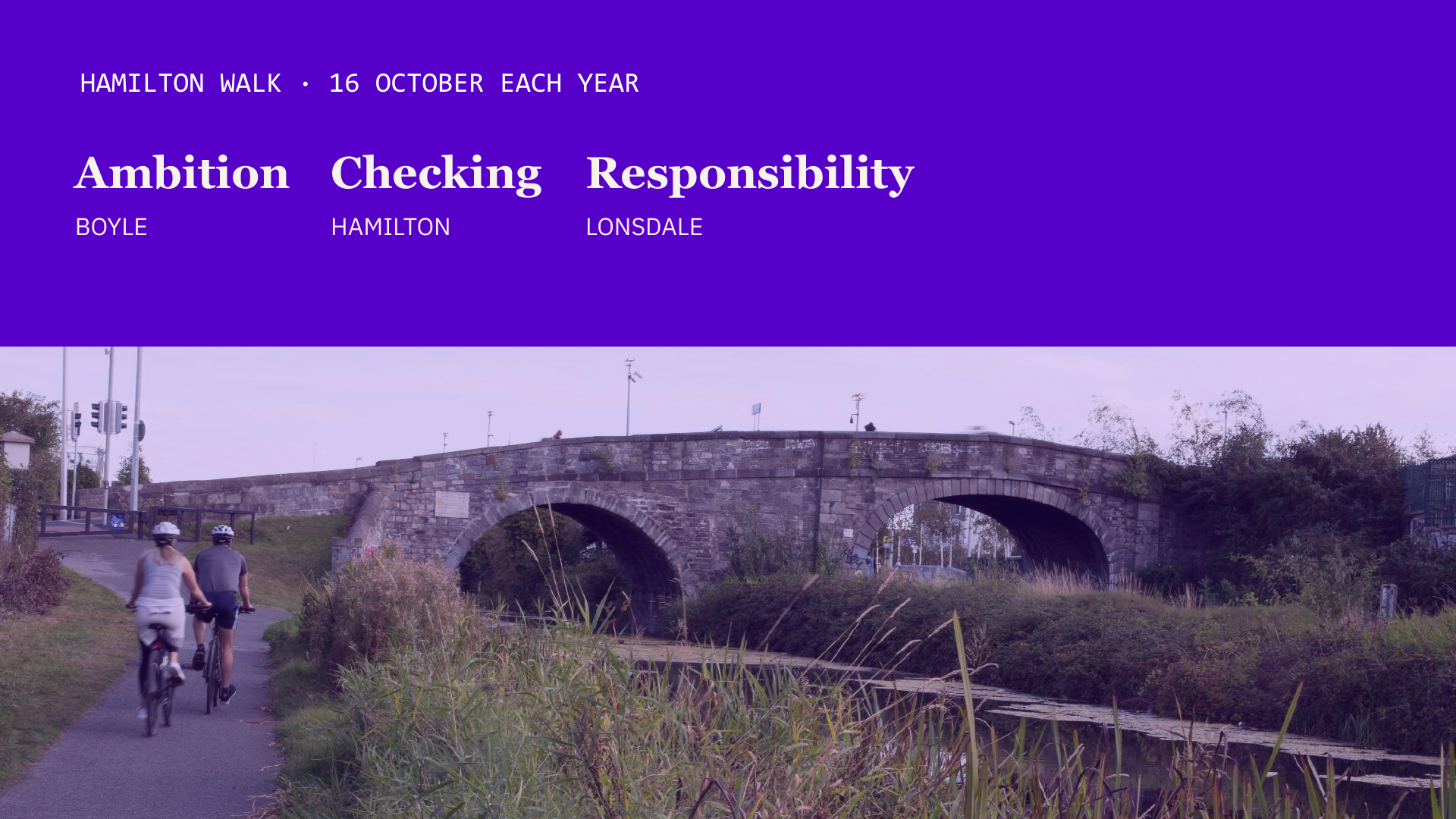
Let me finish on the other side of this city. On the sixteenth of October 1843, tomorrow's date, William Rowan Hamilton was walking with his wife along the Royal Canal, on his way to the Royal Irish Academy. He had been stuck on a problem for years. At Broome Bridge, it came to him. He had nothing to write on, so he took out a penknife and cut the formula into the stone.
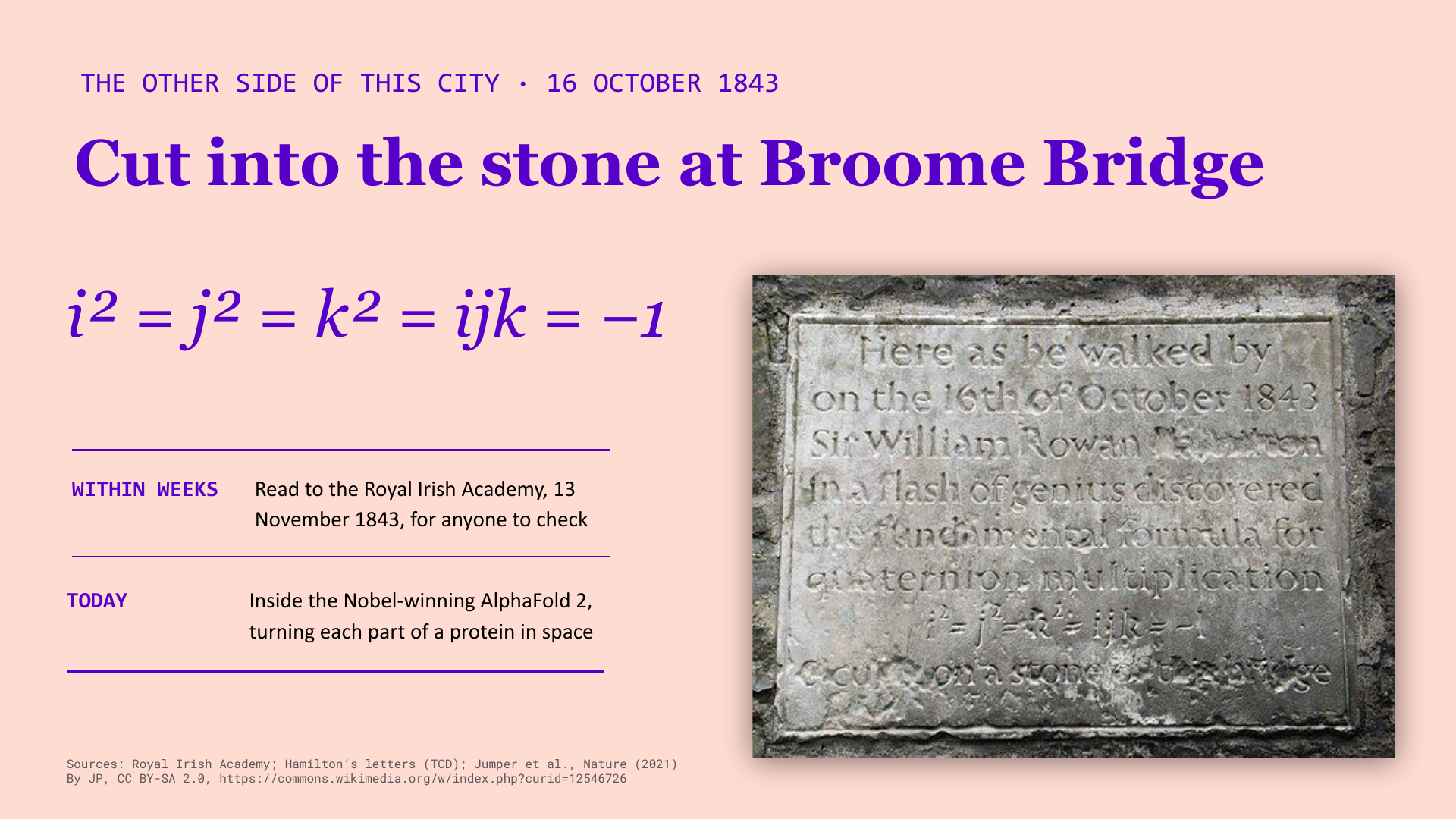
And then he did what scientists do. Within weeks, he had put it in front of his colleagues at the Academy, where anyone could check it. That algebra is inside the Nobel-winning protein model I showed you at the start.
Boyle wrote down what he wanted. Hamilton let others test his idea. Lonsdale insisted that we be accountable for what we build. Ambition, checking, responsibility. That's most of what science asks of us, and all of it is still ours to do.
I've spent much of my working life helping build communities of people who check each other's work: in laboratories, and across a continent the field once overlooked. It is the most hopeful work I know. Many of the next ones will start in rooms like this.
Tomorrow morning, people will walk out along the canal to Broome Bridge for the Hamilton Walk, as they do every year. If you have an hour, go. You'll see where an idea was first written down. What you won't see is everyone who has checked it since. That's the part we get to build.
Science moves at the speed of its checks. So let’s build them.
Thank you.